
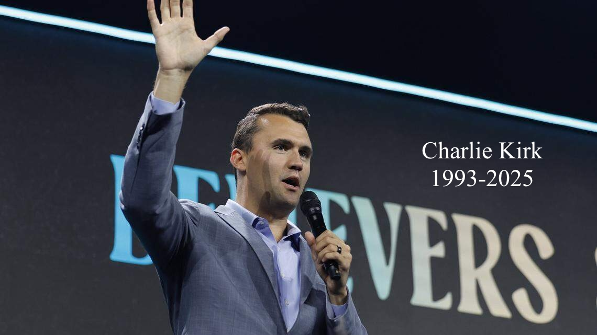
On September 10, 2025, Charlie Kirk was speaking at a Turning Point USA event at Utah Valley University when he was fatally shot. On that day, we lost a bold voice for the Gospel of Jesus Christ. A suspect, Tyler Robinson (22 years old), has been arrested. While motives are still under investigation, reports suggest ideological disagreement, political polarization, and extreme indoctrination may have been factors.
Just before the tragedy, Charlie and his wife, Erika, both shared biblical references on their social media platforms. Erika posted Psalm 46:1: “God is our refuge and strength, a very present help in trouble.” Charlie himself wrote, “Jesus defeated death so you can live.” Even in their last words together publicly, they pointed people to Christ.
I have wept many tears these past few days. Not only because I appreciated Charlie’s voice as someone who shared the Gospel with courage and grace in public spaces, but also because he profoundly impacted my own family. All my adult children are now living for Christ—some of them turning to Jesus in just the past few years. Charlie Kirk’s voice was part of their journey. God used him as a tool in their discipleship process. And for that, I will always be grateful.
LESSONS FOR PASTORS & THE CHURCH
The gravity of political violence and polarization is real. This tragic loss reminds us how deeply divided our society has become—how ideas, rhetoric, and ideology can quickly escalate to violence. As pastors, we are called to shepherd people through division, to promote peace, and to model how Christian love crosses ideological lines, even when we disagree sharply. Charlie Kirk sought to do this with conviction and humility.
Faithfulness in the face of opposition. For those who followed him, Kirk represented someone who spoke boldly—whether one agreed with him or not. There is always a cost to speaking our convictions. The early church suffered, martyrs died, prophets stood alone. Courage is essential in Kingdom work—not for self-glorification, but for truth, integrity, and righteousness.
Mortality reminds us of eternal realities. The unexpected death of a public figure reminds us all of the brevity of life. The Good News we preach is not mere rhetoric—it has eternal consequences. We must ground our ministry not in popularity or safety, but in the Kingdom. Our comfort rests in this truth: “Christ defeated death so you can live.”
Do not let grief lead to vengeance. Romans 12:19 warns us not to take justice into our own hands. Anger is a natural response, especially when evil feels so blatant. But our calling is to be peacemakers, even when that is hard—to pray for the bereaved, to call out evil for what it is, but to never stoop to hatred and violence.
The witness continues beyond death. Hebrews reminds us that Abel still speaks through his testimony after death. Likewise, Kirk’s passing has stirred conversation, reflection, and renewed devotion. A public life has consequences; a public death can amplify voices. Our task as believers is to help people discern carefully what is being said, what message is being spread, and to guide them toward truth—not simply outrage.
Dependence on God in trouble. Psalm 46:1 declares, “God is our refuge and strength, a very present help in trouble.” In dark days, we do not turn first to ideologies or talking points, but to God, who holds all things in His hands. As pastors, our responsibility is to lead our people to find solace, courage, and hope in Christ alone.
LIFE APPLICATION
Pray deeply. First, pray for Charlie Kirk’s family, for his friends and community, and for anyone who is hurt, confused, or frightened by this tragic event. Pray also for our nation—that hearts would soften, that violence would be turned aside, and that reconciliation, not rancor, would be sought.
Teach on biblical justice, grief, and the Gospel. Use this moment to help people think biblically about justice (what does God’s Word teach about justice?), grief (what is healthy grieving?), and the cross (how suffering, sin, and death are defeated in Christ). Bring Scripture to bear and give people language for sorrow that keeps them grounded in the Gospel.
Promote civil and biblical engagement in public discourse. Charlie Kirk engaged public discourse with grace and civility. He engaged anyone willing to step up to the mic. He invited everyone to the table. Encourage your congregation to speak truth boldly, but to do so in love. To stand firm in convictions, yet be slow to anger and quick to listen.
Model courage in ministry. Courage may mean speaking unpopular truths, standing for the oppressed, being transparent in suffering, and upholding integrity even when it costs. Encourage leaders and laypeople to serve faithfully, not for personal acclaim, but for the Kingdom.
Provide pastoral care. Ensure intentional care for those shaken by this event—especially young people who may feel the world is less safe, and those who identified with Kirk’s vision. Help them find hope, not fear—faith, not despair.
ENCOURAGING WORD
Brothers and sisters, Christian ministry is never risk-free. Yet we labor not for our own name, but for the name of Christ. Our legacy is not engraved in stone but in lives transformed, in faithfulness lived out, and in seeds planted for the Kingdom.
Charlie Kirk’s death is a tragedy. But death does not have the final word. Jesus does. And His victory over the grave calls us to live with courage, hope, love, and truth. Let us press on, strengthened by His Spirit, seeing every trial as an opportunity to shine the light of Christ into a darkened world.
 Brian L Powell